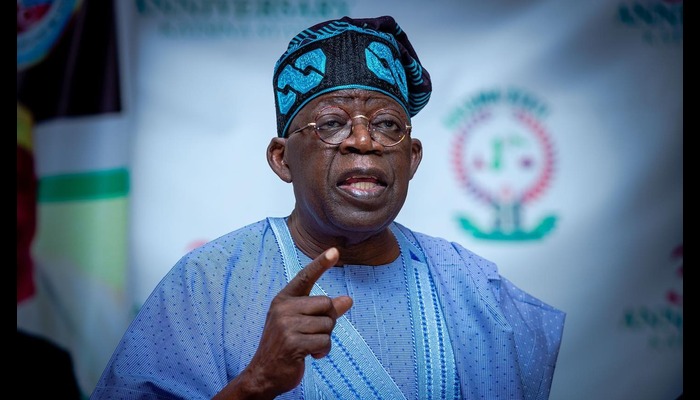
President Bola Tinubu on Tuesday affirmed that his government would continue with its economic reforms and would not reverse course.
He further pledged to uphold transparency and accountability in governance.
Speaking at the State House in Abuja while receiving a World Bank delegation led by Managing Director of Operations Anna Bjerde, Tinubu said the reforms, though initially difficult, are essential to strengthen Nigeria’s economy and create opportunities for its youth.
“Since we went into this journey of reform, we have our hands on the plow, and we’re never going to look back.
“It is very clear that initially it was painful and difficult, but those who win are not those who give up along the way in their difficult times,” the President said.
He stressed that Nigeria, as the heart of Africa, must take steps to transform its economy, particularly through agricultural mechanisation and support for farmers.
Tinubu specifically called on the World Bank to assist in setting up mechanisation centres, boosting seedling programmes, and improving access to locally produced fertilisers as Nigeria’s petrochemical industry expands.
“How do we help the farmers to convert local market for fertilisers to improve their yields and move them from ordinary small-scale holders to huge cooperatives and commercial farmers that can bring opportunity to Nigerians?” he asked.
The President acknowledged that his reform agenda required tough decisions, including ending the fuel subsidy and unifying the exchange rate, despite initial inflationary pressures.
“It was difficult for a leader to look the other way in any corrupt environment for an opportunity that can give a function of money in subsidy regime and multiple exchange rates.
“We gave it up, let the world and the country benefit from a stable currency.
“And yes, the first reaction was high inflation, but it has come down dramatically. Naira is stable today,” Tinubu added.
He encouraged the World Bank to explore financing options that could accelerate Nigeria’s growth, cut intermediaries, manage risks, and build Nigerians’ skills.
“What is the value of encouragement for an Africa that is taking this huge population on an assurance of prosperity?
“How can you accelerate that growth in partnership with us?
“Any way that we can cut brokers and push the risk and develop the skill of our people is why I’m seeing you this afternoon,” he said.
Responding, Bjerde praised Tinubu’s consistent implementation of reforms over the past two years, describing the results as “remarkable and commendable.”
She noted that Nigeria has become a frequent reference in her discussions with global presidents, policymakers, and investors due to its achievements during this period.
“In these two years, the results that have been achieved are really commendable, and what I have particularly appreciated and followed is your steady direction that you communicate to the people of Nigeria, as well as outside of Nigeria, of the importance of their reforms, because that has given confidence and clarity that even when reform implementation can be difficult, there is no turning back,” Bjerde said.
She highlighted that while many countries slow down or reverse reforms during hard times, Tinubu has remained steady, a fact widely noted internationally.
“Two years ago, you were very much at the launching stage, and here we are, two years later, with very strong results.
“We heard it from the private sector in Lagos on Sunday as well as yesterday, and I think it’s just remarkable and commendable,” the World Bank official added.
Bjerde explained that under World Bank President Ajay Banga, the Bank’s strategies align with member countries’ national visions, with Nigeria’s $1tn GDP target and seven per cent growth serving as the framework for support.
She emphasised job creation as central to the Bank’s partnership with Nigeria, noting Africa’s growing population as both a challenge and an opportunity.
“In 2051, one in four people will be an African, and 40 per cent of those will be young people. Africa alone needs 600 million additional jobs by 2050.
“So jobs is what we’ve identified as something very important, because the best way out of poverty ultimately is that people have their own livelihoods and incomes,” she said.
The World Bank official also pointed to infrastructure development as vital, noting Nigeria’s relatively low infrastructure spending per GDP and the need for both public and private sector solutions.
On agriculture, Bjerde lauded Nigeria’s innovations and said the Bank is committed to scaling them through mechanisation, cooperatives, and better integration into value chains, including roads, finance, and technology.
She addressed financing challenges for small and medium-sized enterprises, which create most jobs globally but often struggle to access funds.
“Some of the small ones have access to microfinance. Some of the large ones can establish themselves and have access to banks.
“The middle ones are a bit lost. So that’s where the access to finance solutions we think we need to creatively work on together,” Bjerde said.
On human development, she praised Nigeria’s approach to addressing stunting, highlighting early childhood development as a key area for Bank support.
Bjerde disclosed that the World Bank’s portfolio in Nigeria totals about $17bn in the public sector, making the country one of its largest clients.
She added that the International Finance Corporation handles about $5bn annually in private sector operations in Nigeria, while the Multilateral Investment Guarantee Agency provides over $500m in risk reduction support, with plans to expand.
She revealed that the Bank is preparing a new Development Policy Operation to support Nigeria’s budget in line with its reform agenda.
“Because you’re so reform-oriented, it’s the perfect instrument, because it’s your reforms and our support to the budget. So they go hand in hand,” Bjerde said.
The official noted that inflation has declined significantly, while the Bank will continue supporting reforms in trade, digital infrastructure, and other areas essential for job creation and private sector growth.
“Yesterday, we heard from the private sector that for youth, digital is the fuel. So all the work you’re doing on digital is just amazing, because that’s where their energy comes from and goes to,” she added.
She concluded by noting that Nigeria consistently attracts international attention as a key African country to watch.
“I’m really honoured to meet you again. Sorry if I talk too much about Nigeria around the world. I often get the question of which country should we be tracking in Africa, and Nigeria is always top of my mind,” Bjerde said.
