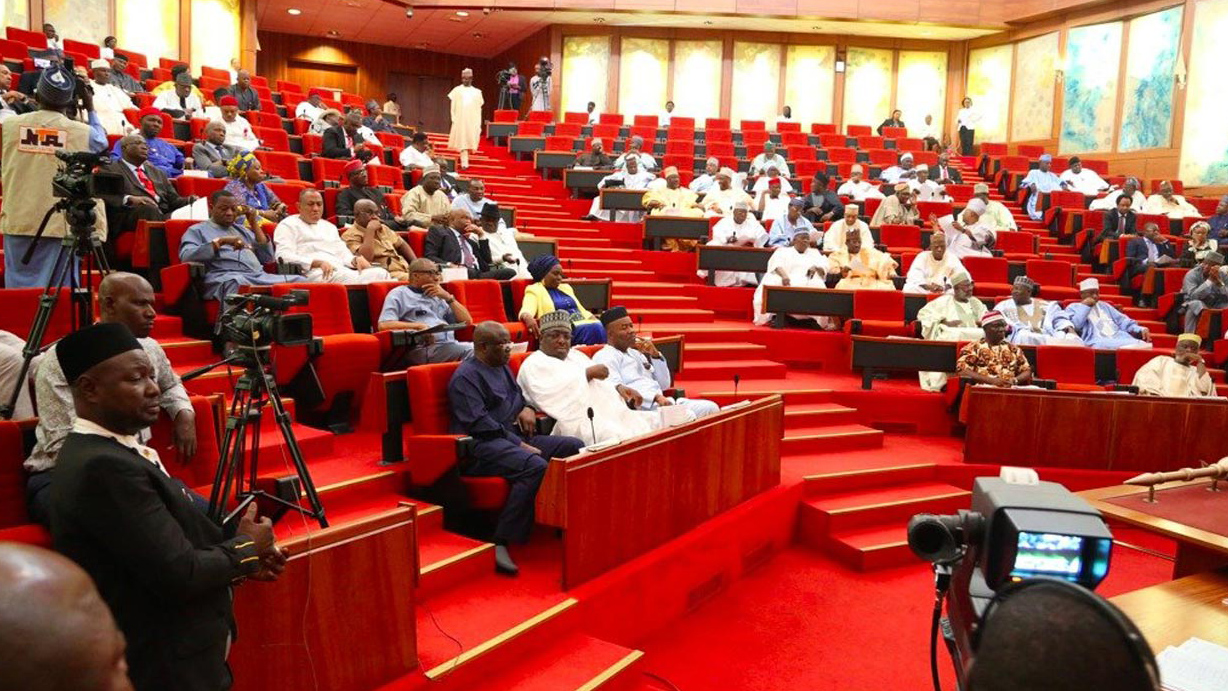
The Senate has said Nigeria will continue borrowing to cover its huge budget deficit, even as many Nigerians complain about the rising national debt.
It also promised to end the long-standing practice of extending unimplemented budgets, warning Ministries, Departments and Agencies (MDAs) to prepare for closer scrutiny.
The National Assembly further stated it will no longer approve extensions for budget implementation, stressing that strict timelines, stronger oversight, and better fiscal discipline will guide the execution of the 2026 Appropriation Act.
At a public hearing on “The 2026 Appropriation Bill,” organised by the Senate Committee on Appropriations, the committee chairman, Senator Olamilekan Adeola (APC, Ogun West), said borrowing had become unavoidable due to limited revenues and huge development needs. He said: “Never again will the National Assembly approve budget extensions. We must discipline our budgeting cycle, enforce strict adherence to appropriation timelines and ensure better coordination between policy design and implementation.”
Adeola noted that, although public opposition to borrowing continues, Nigeria’s infrastructure gaps and development challenges leave the government little choice. He emphasised that the key issue is not borrowing itself, but how deficits are financed.
“Nigeria cannot help but keep borrowing because revenue inflows are unpredictable and development needs are enormous. What matters is how we borrow and how we fund our deficits,” he said.
He stressed the need for Nigeria to protect its credit rating and international reputation, adding that the government is limiting domestic borrowing to avoid crowding out private sector credit. Alternatives being explored include asset optimisation, privatisation, Public-Private Partnerships (PPPs), joint venture asset leveraging, and Eurobond issuances.
“Government is deliberately avoiding excessive domestic borrowing that could crowd out private sector credit. Instead, we are exploring external financing, asset sales and privatisation to bridge revenue gaps,” Adeola explained.
On the 2026 budget, estimated at N58.47 trillion, Adeola called it a “Budget of Consolidation,” based on subsidy removal, tax reforms, public finance restructuring, and electricity sector reforms. He stressed that the budget’s success depends on effective implementation and people-focused results. Projected revenue stands at N33.19 trillion, leaving a deficit of about N25.27 trillion.
Debt servicing is projected at N15.90 trillion, while capital expenditure of N23.21 trillion reflects government focus on infrastructure and productivity.
Adeola warned heads of MDAs to take budget defence seriously, saying failure to justify proposals could lead to reallocation of funds. He also reaffirmed that all government funds, including service-wide votes, remain subject to legislative oversight.
Economist and fiscal policy expert, Dr. Olatilewa Adebanjo, cautioned that Nigeria’s rising budget deficit could become unsustainable without urgent reforms in revenue mobilisation and fiscal discipline. He called for a full review and stricter enforcement of the Fiscal Responsibility Act (FRA), describing it as a powerful but underused law.
“We need to remain alert and proactive. All stakeholders must closely monitor critical sectors to ensure revenues meant for government actually reach government coffers,” Adebanjo said.
He raised concerns about the mining and solid minerals sector, alleging major revenue leakages. He accused foreign companies, especially Chinese firms, of extracting Nigeria’s resources with minimal benefit to the country.
“What we continue to see is a situation where foreign actors, especially Chinese interests, come into the country, extract our mineral resources and leave with enormous value, while Nigeria earns little or nothing in return. This is a wake-up call,” he said.
Adebanjo also criticised unrealistic revenue projections, urging the government to base budgets on achievable figures and hold revenue-generating agencies accountable for results.
Accountant-General of the Federation (AGF), Shamseldeen Ogunjimi, also criticised Nigeria’s budgeting system, saying the country has long been strong in budget planning but weak in execution. He said: “Budget is not a spreadsheet; it is not a ritual of numbers; it is not merely an annual legal requirement.”