
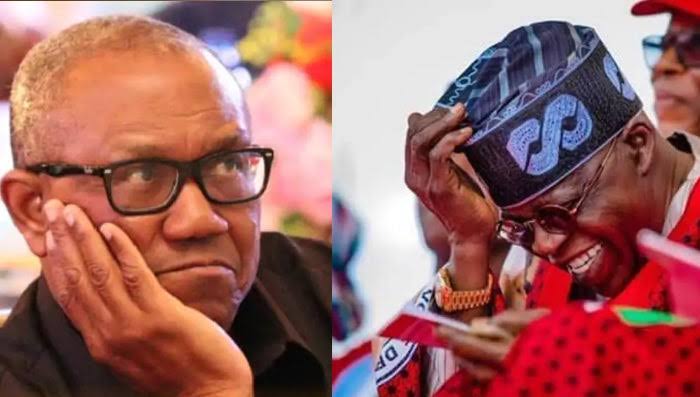
Former Labour Party presidential candidate, Peter Obi, didn’t hold back on Thursday as he slammed President Bola Tinubu.
Obi claimed that the late military ruler, General Sani Abacha, acted more democratically than Tinubu and his colleagues in the now-defunct pro-democracy group, NADECO.
For context, NADECO was a pro-democracy group formed on May 15, 1994. It brought together top activists, political figures, and groups like the pan-Yoruba group, Afenifere, all fighting to end military rule in Nigeria.
The group had big names like Chief Michael Adekunle Ajasin, Chief Anthony Enahoro, Commodore Ebitu Ukiwe, Chief Abraham Adesanya, Admiral Ndubuisi Kanu, and Dr Beko Ransome-Kuti. Other notable members included Professor Wole Soyinka, Balarabe Musa, Chief Olu Falae, Chief Ganiu Dawodu, and Tinubu, who played key roles as strategist and financier.
On X (formerly Twitter) Thursday, Obi accused Tinubu and some of his allies—once hailed defenders of democracy during military rule—of turning into destroyers of democracy today.
He wrote, “Yesterday defenders of democracy, today’s destroyers. What a shame. What an irony of history, that the acclaimed defenders of democracy and human rights who claimed to have fought for democracy during the era of General Sani Abacha now find themselves worse than the man they opposed.”
Obi’s dig came amid a controversy around the Independent National Electoral Commission (INEC) derecognising executive members of the African Democratic Congress (ADC) led by David Mark. The commission also refused to deal with the party’s factional leader, Nafiu Gombe, until a court settles an ongoing dispute.
INEC said in a statement Wednesday that the decision followed a review of Appeal No. CA/ABJ/145/2026, linked to leadership issues within the ADC.
The commission added it would remove the names of Mr Mark’s faction from its portal to maintain the “status quo ante bellum,” as instructed by the court. This means no one would be officially recognised as the party’s leader or executive member until the case concludes at the Federal High Court, Abuja.
Obi hit back on X again, saying, “Today, General Sani Abacha, once presumed face of oppression, will be remembered as seemingly more democratic and more respectful of human rights than the so-called champions of activism from the NADECO days. Power indeed reveals character.”
The ADC crisis started in July 2025 when Mr Mark led a new National Working Committee after some executives resigned. But Mr Gombe, the former vice-national chairman, rejected the changes, claiming he never resigned and should automatically lead under the party’s constitution.
Gombe went to court to stop Mark’s team from acting as party leaders and to get INEC to recognise him instead. Mark’s group challenged the case at the Court of Appeal, arguing the lower court had no power over it. But the Appeal Court dismissed the appeal, confirming the Federal High Court would continue the case.
After the Appeal Court ruling Wednesday, INEC said it would obey the judgment, maintain the current situation, and warned politicians to respect the courts to avoid messing with 2027 election plans.