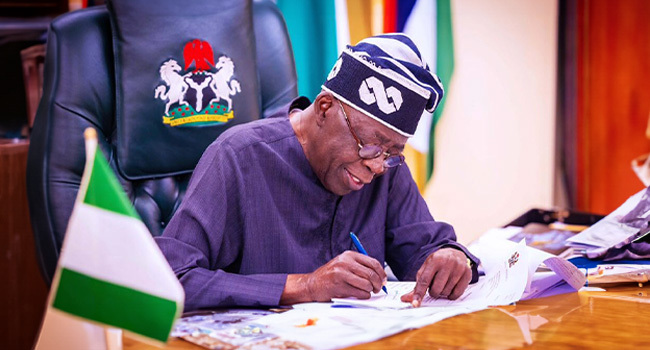
President Bola Tinubu on Wednesday signed the Electoral Act Amendment Bill 2026 into law, even as Nigerians protested a controversial clause making electronic transmission of election results optional.
The signing took place at the Presidential Villa in a brief ceremony attended by Senate President Godswill Akpabio, Speaker of the House Abbas Tajudeen, Senate Leader Opeyemi Bamidele, Deputy Speaker Benjamin Kalu, and other top officials.
With his signature, the bill is now law, meaning future elections in Nigeria will follow the amended rules.
The National Assembly had passed the bill on Tuesday after months of debates. Out of its 154 clauses, Clause 60—which allows electronic transmission of results to remain optional—caused the most disagreement.
Originally, the House of Representatives approved a version in December requiring electronic transmission of results from polling units to INEC’s Result Viewing Portal (IReV) immediately after counting.
The Senate rejected this mandatory approach, keeping the 2022 Electoral Act provision that allows results to be sent to collation centres without compulsory electronic transmission.
Many Nigerians criticised the Senate’s stance, urging lawmakers to stick with the House version.
On Tuesday, the Senate reconvened and confirmed that electronic transmission would remain optional. The clause also states that if the internet fails, Form EC8A will be the primary record for collating results.
Form EC8A is the document where presiding officers record votes right after counting at polling units. Courts often rely on it during election petitions, as it represents the first official vote record.
Some Nigerians and civil society groups were still unhappy, staging protests at the National Assembly and pushing for mandatory electronic transmission.
During Tuesday’s plenary, senators voted on whether electronic transmission should be compulsory.
Fifty-five senators, including Deputy Minority Leader Oyewunmi Olalere and Adamawa North Senator Amos Yohana of the Peoples Democratic Party (PDP), supported keeping it optional. Mr Olalere acted as minority leader during the vote.
Fifteen senators, including Enyinnaya Abaribe, Victor Umeh (Anambra), Natasha Akpoti-Uduaghan (Kogi), Ireti Kingibe (FCT), Seriake Dickson (Bayelsa), Aminu Tambuwal (Sokoto), and Abdul Ningi (Bauchi), wanted electronic transmission to be mandatory.
Senate President Akpabio announced that the chamber would stick to its earlier position, keeping electronic transmission optional.
The House of Representatives, which had initially demanded mandatory electronic transmission, later aligned with the Senate during Tuesday’s plenary.
Before the signing, several Nigerians and election-monitoring groups urged President Tinubu to reject the bill unless the clause was changed to make electronic transmission compulsory. The president, however, proceeded to sign it.
At the ceremony, Tinubu praised lawmakers, especially the principal officers, for managing the controversy and ensuring smooth passage of the bill.
“It’s not as important as the historical aspects of this. What is crucial is the fact that you manage the process to the extent that there will be no confusion, no disenfranchisement of Nigerians, and that we are all going to see democracy flourish.
“No matter how good the system is, it’s managed by the people, promoted by the people, and the result is finalised by the people,” he said.
On electronic transmission, Tinubu said the amendment still supports transparency while reducing technical risks. He argued that Nigeria might not yet have the technical capacity to handle mandatory real-time transmission.
“In fact, for final results, you are not going to be talking to the computer; you are going to be talking to human beings who will announce the final results. And when you look at the crux of various arguments, maybe Nigerians should question our broadband capability. How technically are we today? How technically will we be tomorrow to answer the call of either real-time or not?
“And as long as you appear personally, as a manual voter in any polling booth, a ballot paper is given to you manually, you decide in a corner and thumbprint the passing of your choice, you cast your votes, without hindrance and any interference, ballots are subsequently counted manually, sorted, and counted manually,” he added.
Tinubu also said relying on Form EC8A would help avoid glitches and hacking, praising lawmakers for making electronic transmission optional.
“It’s just the arithmetic accuracy that is to enter into Form EC8A. It’s the manual, essentially. The transmission of that manual result is what we’re looking at. And we need to avoid glitches. I’m glad you did — interference, unnecessary hacking in this age of computer inquisitiveness.
“Nigeria will be there. We will flourish. We will continue to nurture this democracy for the fulfilment of our dream for the prosperity and stability of our country,” he said.